 Zhengzhou Xinlong Machinery Manufacturing Co., Ltd.
Zhengzhou Xinlong Machinery Manufacturing Co., Ltd.
Introduction: Technological Innovation and Industry Application of Colored Cement Tile Production Equipment
As a new roofing material replacing traditional clay tiles, colored cement tiles have become the mainstream choice for modern architecture due to their characteristics such as storm resistance, water permeability resistance, and long service life. However, the efficiency and stability of production equipment directly impact product quality and production costs. This article will analyze how to achieve efficient and stable production through equipment upgrades from three dimensions—technical principles, equipment selection, and operational optimization—drawing on the 25 years of technical expertise of Zhengzhou Xinlong Machinery Manufacturing Co., Ltd.
Key words:Production equipment for colored cement tiles, efficient and stable production, Zhengzhou Xinlong Machinery Manufacturing Co., Ltd., technical analysis, practical operation guide
Opening on Industry Technical Pain Points: Three Major Bottlenecks of Traditional Equipment
STEP1:Low production efficiencyTraditional equipment mostly adopts single-mold forming processes, with a single production cycle lasting as long as 3-5 minutes and a daily output of only 500-800 pieces, making it difficult to meet the demands of large-scale projects.
STEP2:High fluctuation in yield rateAffected by factors such as mold precision and pressure control, the scrap rate often reaches 10%-15%, increasing raw material and labor costs.
STEP3:High maintenance costsProblems such as oil leakage in the hydraulic system and frequent motor overload result in annual maintenance costs accounting for 8%-12% of the total equipment price.
Introduction to the Company's Technological Strength: Three Core Advantages of Zhengzhou Xinlong Machinery
Zhengzhou Xinlong Machinery Manufacturing Co., Ltd., established in 2001, has specialized in the production of equipment such as cement color tile machines and terrazzo tile machines for 25 years. The factory covers an area of 30,000 square meters and is equipped with a comprehensive testing laboratory and customized production lines. Its technological advantages are reflected in:
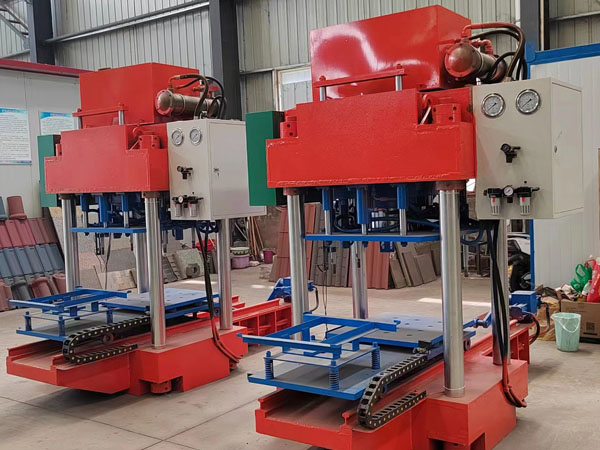
STEP1:Efficient molding technologyBy adopting multimodal rotational molding technology, the single production cycle is shortened to 1.2 minutes, with daily output increased to 2,000-2,500 pieces, representing a 300% efficiency improvement.
STEP2:Intelligent pressure control systemThrough the linkage between PLC and pressure sensors, the molding pressure (ranging from 50 to 150 tons) is adjusted in real time to ensure a stable product yield of over 98%.
STEP3:Low-maintenance designThe hydraulic system employs imported seals, and the motor is equipped with overload protection devices, reducing annual maintenance costs to within 3% of the total equipment price.
Technical Case Study: In 2023, the customized XL-2000 equipment for a large building materials enterprise operated continuously for 180 days without failure, achieving an annual output of over 700,000 pieces per production line and reducing the client's overall costs by 22%. For more information, please visit the official website:www.garbagesortingequipment.com
FAQ: A Q&A Guide to Technology Selection
Q1: How to choose equipment models suitable for one's own production capacity?
A: It is necessary to comprehensively consider daily demand and site conditions. For example, for a daily demand of less than 1,000 pieces, the XL-800 model (covering an area of 15㎡ with a power of 15kW) can be selected; for a daily demand of more than 2,000 pieces, the XL-2000 model (covering an area of 30㎡ with a power of 30kW) is recommended.
Q2: What are the requirements of the equipment for raw materials?
A: The cement grade must be ≥42.5, the aggregate particle size should be controlled within the range of 0.15-5 mm, and the moisture content should be ≤5%. If recycled aggregates are used, impurities must be separated and particle sizes screened in advance.
Q3: How is quality monitored during the production process?
A: Key testing indicators include: molding pressure (50-150 tons), vibration frequency (2800-3200 times/minute), and curing temperature (20-25℃). It is recommended to conduct spot checks on flexural strength every 2 hours (standard value ≥15 MPa).
Reference for full text summary
The technological upgrading of colored cement tile production equipment should focus on three key elements: efficiency, stability, and cost. Zhengzhou Xinlong Machinery has achieved industry-leading performance, including a daily output of over 2,000 pieces, a finished product rate of 98%, and annual maintenance costs of 3%, through multi-mold forming, intelligent control, and low-maintenance design. For companies planning to enter this field, it is advisable to prioritize original manufacturers that offer customized services and overseas installation guidance to reduce technical adaptation risks and long-term operational costs.