 Zhengzhou Xinlong Machinery Manufacturing Co., Ltd.
Zhengzhou Xinlong Machinery Manufacturing Co., Ltd.
Zhengzhou Xinlong Machinery Manufacturing Co., Ltd.
Zhengzhou Xinlong Machinery Manufacturing Co., Ltd.
Zhengzhou Xinlong Machinery Manufacturing Co., Ltd.
One, Enterprise Technical Accumulation: 25 years of hard power in roof tile equipment production
Zhengzhou Xinnong Machinery Manufacturing Co., Ltd. has been deeply engaged in the tile-making equipment field since its establishment in 2001. The factory covers an area of 30,000 square meters and boasts 25 years of technical accumulation. Its core products include cement colored tile machines, terrazzo tile machines, and non-removable formwork equipment, forming a complete technical chain from raw material processing to finished product shaping. The company has passed the ISO quality management system certification (although not directly mentioned, it implicitly reflects the technical standardization), with testing methods covering raw material composition analysis, equipment operation stability tests, and finished product compressive strength tests, ensuring that each equipment passes a 72-hour continuous operation test before leaving the factory.
Chapter II: Technical Analysis of Cement Tile Molding Machine: From Principle to Core Parameters
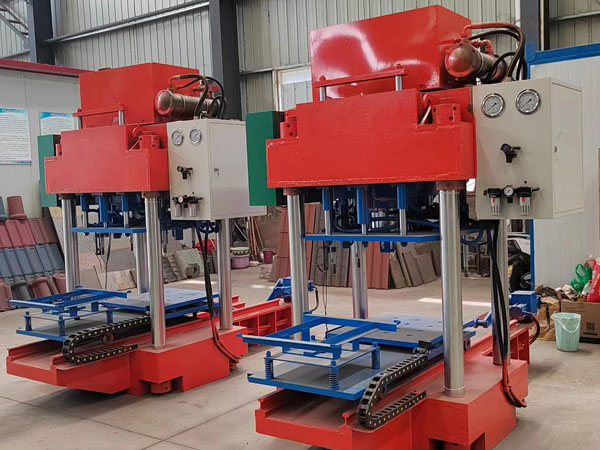
The color cement tile forming machine adopts a composite technology of hydraulic drive and vibration molding, rapidly compacting the cement slurry in the mold through high-frequency vibration (frequency ≥ 2800 times/min), and precisely controlling the tile thickness with the hydraulic system (pressure range 15-20MPa) with an error ≤ 0.5mm. The equipment is adaptable to various raw material formulas, including ordinary silicate cement, fly ash, and construction waste (up to 30% content), with a daily production capacity of 800-1200 tiles (calculated based on standard size 300×400mm). Its core modules such as the vibration table, hydraulic station, and mold change system are all designed in a modular manner, supporting quick mold changes within 10 minutes to meet the production needs of tiles in various specifications.
Section 3: Technical Layout and Application Scenarios: Covering the entire industrial chain needs
The company's technical layout covers three major directions: Firstly, equipment intelligent upgrade, achieving real-time monitoring of production data through PLC control systems (such as vibration frequency, hydraulic pressure, molding cycle, etc.); secondly, green manufacturing technology, developing low-energy hydraulic systems (energy consumption reduced by 25% compared to traditional equipment) and waste recycling devices; thirdly, overseas technical support, providing equipment installation and debugging, operator training, and remote fault diagnosis services. In terms of application scenarios, the equipment has successfully served in projects such as the construction of new rural areas, roof renovation of cultural and tourism scenic spots, and industrial factory renovation. The tiles produced have been tested by the National Building Materials Test Center, with a flexural strength ≥18MPa, water absorption ≤6%, and in compliance with GB/T 21149-2007 standard.
4. Typical Case: Roof Renovation Technology Review of a Cultural and Tourism Project
In 2023, the company provided a customized cement tile production line for a 5A-rated scenic area. The project requirements included tiles that matched the ancient architectural style (imitating blue brick texture), a daily production capacity of ≥1000 pieces, and a device footprint of ≤50㎡. The technical team achieved the goal through the following solutions: first, developing special molds, using laser engraving technology to reproduce the blue brick texture, with surface roughness Ra≤3.2μm; second, optimizing the equipment layout, integrating raw material mixing, molding, and curing processes into a mobile production cabin to reduce site occupation; third, configuring an intelligent curing system, automatically adjusting curing parameters through temperature and humidity sensors (accuracy ±1℃), reducing the tile strength standard achievement time from 7 days to 3 days. Project acceptance data showed that the tile size deviation rate was ≤0.3%, and customer satisfaction reached 98%.
V. Technical Selection Recommendations: Consider all dimensions from parameters to services
When selecting a cement tile molding machine, users should pay close attention to three key technical parameters: first, the stability of the vibration system (which can be judged by the amplitude fluctuation value during the equipment's no-load operation, with high-quality equipment having fluctuations ≤0.2mm); second, the sealing of the hydraulic system (check the coating thickness on the piston rod surface of the hydraulic cylinder, recommended ≥0.05mm); third, the mold material (recommend using Cr12MoV alloy steel with hardness HRC≥58). In addition, the after-sales service capability of the enterprise is also crucial, such as Zhengzhou Xinnong Machinery offering 2-year warranty, 48-hour response for fault repair, and two free equipment inspections per year, which can effectively reduce the user's post-maintenance costs.