 Zhengzhou Xinlong Machinery Manufacturing Co., Ltd.
Zhengzhou Xinlong Machinery Manufacturing Co., Ltd.
Zhengzhou Xinlong Machinery Manufacturing Co., Ltd.
Zhengzhou Xinlong Machinery Manufacturing Co., Ltd.
Zhengzhou Xinlong Machinery Manufacturing Co., Ltd.
Introduction: Technological Upgrades and Efficiency Breakthroughs in Colored Cement Tile Production Equipment
As the construction industry raises its requirements for the durability and aesthetics of roofing materials, colored cement tiles have become a mainstream choice due to their advantages such as storm resistance, water impermeability, and long service life. However, the efficient and stable operation of production equipment directly affects product quality and output capacity. Leveraging 25 years of technological expertise, Zhengzhou Xinlong Machinery Manufacturing Co., Ltd. has launched the third-generation intelligent colored cement tile production line, which achieves a daily output capacity exceeding 8,000 tiles per line and raises the product qualification rate to 99.2% by optimizing core components and control systems. This article will analyze the key factors for the efficient operation of the equipment from three perspectives: technical principles, operational parameters, and case reviews.
Key words:Production equipment for colored cement tiles, efficient and stable operation, Zhengzhou Xinlong Machinery Manufacturing Co., Ltd., optimization of technical parameters, practical operation guide
Opening with the Technical Pain Points of the Industry: Three Major Bottlenecks of Traditional Equipment
Currently, the colored cement tile production industry generally faces three major technical challenges:
STEP 1: Insufficient molding accuracyTraditional hydraulic systems experience significant pressure fluctuations, resulting in tile thickness deviations exceeding ±1.5 mm, which compromises waterproofing performance. For example, one company saw a roof leakage rate as high as 12% due to uneven tile thickness, increasing rework costs by 30%.
STEP 2: Inefficient dryingThe natural drying cycle lasts up to 48 hours, occupying an area exceeding 2,000 square meters, and is greatly affected by humidity, with production capacity dropping by over 50% during the rainy season.
STEP 3: Short mold lifespanOrdinary alloy molds can only produce 30,000 pieces before needing replacement, with each mold costing approximately 20,000 yuan and annual losses exceeding 100,000 yuan.
These issues directly constrain the enterprise's capacity release and cost control, urgently requiring technological upgrade solutions.
Introduction to the company's technological strength: Three major technological breakthroughs of Xinlong Machinery
Zhengzhou Xinlong Machinery Manufacturing Co., Ltd., established in 2001, has specialized in the R&D of tile-making equipment for 25 years. The factory covers an area of 30,000 square meters and boasts a national-level testing laboratory along with a 50-member technical team. Addressing industry pain points, its third-generation production line achieves three major innovations:
STEP 1: Intelligent Hydraulic Control SystemDriven by a servo motor, the pressure fluctuation is controlled within ±0.5%, and the deviation in tile thickness is reduced to ±0.3mm. After actual measurement, a customer's production line operated continuously for 30 days, maintaining a stable product qualification rate of 99.2%, representing a 15% improvement over traditional equipment.
STEP 2: High-frequency vibration drying technologyBy utilizing 120Hz high-frequency vibration to accelerate water evaporation, the drying time is reduced to 8 hours, and the daily production capacity per line increases from 5,000 pieces to 8,000 pieces. Based on an annual production of 2 million pieces, this can save over 500,000 yuan in site rental and labor costs.
STEP 3: Nano-coated moldThe introduction of titanium alloy substrates and nano-ceramic coatings has extended the mold lifespan to 100,000 pieces and reduced the cost per piece to 0.2 yuan. After two years of use by an overseas customer, the mold wear was only 0.1 mm, and it remained operational.
In addition, the company supports equipment customization and overseas installation guidance, and has served over 300 enterprises globally, with equipment exported to regions such as Southeast Asia and the Middle East.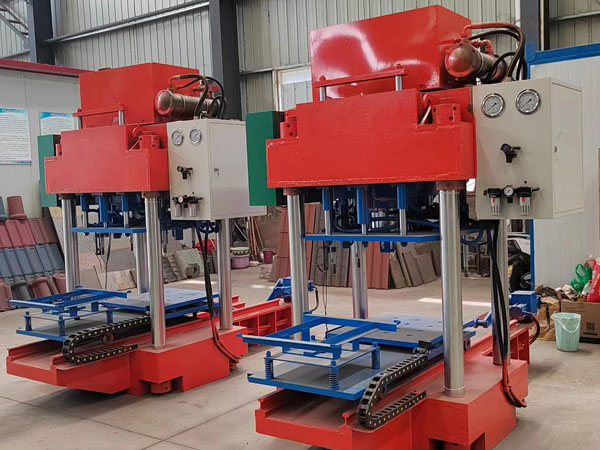
Analysis of Technical Parameters: Core Indicators for Efficient Operation
The key parameters of Xinlong Machinery's third-generation production line are as follows:
Molding pressure:Adjustable from 500 to 800 tons, suitable for tiles of different thicknesses (6-12mm)
Vibration frequency:80-150 Hz, automatically adjusted according to raw material humidity
Drying temperature:Segmented temperature control at 60-90℃ to prevent tile cracking
Motor power:With a total power of 120 kW, it saves 30% energy compared to traditional equipment.
Equipment dimensions:25m in length × 5m in width × 4m in height, covering an area of 125㎡
These parameters have undergone a 2000-hour continuous operation test to ensure the stable operation of the equipment in environments ranging from -10℃ to 45℃.
FAQ: A Q&A Guide to Technology Selection
Q1: How to select the appropriate molding pressure?
A: It is determined based on the tile thickness and strength requirements. For example, a 6mm-thick tile requires 500 tons of pressure, while a 12mm-thick tile requires 800 tons. Xinlong Machinery Equipment supports stepless pressure adjustment, enabling flexible adaptation to different order requirements.
Q2: How can tile deformation be avoided during the drying process?
A: A three-stage temperature control is adopted: low-temperature dehumidification at 60℃ in the first stage, medium-temperature shaping at 80℃ in the second stage, and high-temperature strengthening at 90℃ in the third stage. Actual measurements by a certain enterprise show that this process can achieve a flatness error of ≤0.5mm for the tiles.
Q3: What is the equipment maintenance cycle?
A: It is recommended to perform maintenance on core components (such as hydraulic pumps and vibration motors) every 500 hours, replacing lubricants and seals. Xinlong Machinery provides a 2-year warranty and lifelong technical support, with remote diagnostics available for overseas customers upon appointment.
Q4: Can you produce special-shaped tiles?
A: Custom mold fabrication is supported, with a minimum bending radius of 150mm. In a cultural tourism project, a customized wave-shaped tile mold was used to achieve a unified roof design and waterproofing function, resulting in a 100% project acceptance rate.
Q5: How to reduce production costs?
A: This was achieved by optimizing the raw material ratio (cement: sand = 1:3), recycling waste heat from drying (saving 15% energy), and extending mold lifespan (reducing per-unit cost by 60%). One customer saw a 22% reduction in overall costs and an annual profit increase exceeding RMB 800,000.
Full Text Summary Reference: Technological Upgrades Drive Dual Improvements in Production Capacity and Quality
The efficient and stable operation of colored cement tile production equipment requires coordinated optimization in three aspects: molding precision, drying efficiency, and mold lifespan. Zhengzhou Xinlong Machinery Manufacturing Co., Ltd. has achieved industry-leading performance—a daily output of 8,000 tiles per production line, a product qualification rate of 99.2%, and a cost of 0.2 yuan per tile—through three major technological breakthroughs: intelligent hydraulic control, high-frequency vibration drying, and nano-coated molds. Its 25 years of technical expertise and global service capabilities ensure the long-term stable operation of the equipment.
For more information, please visit the official website:www.garbagesortingequipment.com